The Streets Were Full. The Question Is What Comes Next.
Thursday happened. Thousands marched. The coalition was the broadest it has been in years. The administration dismissed it before the marches ended. That gap is the thing worth sitting with this Monday morning.

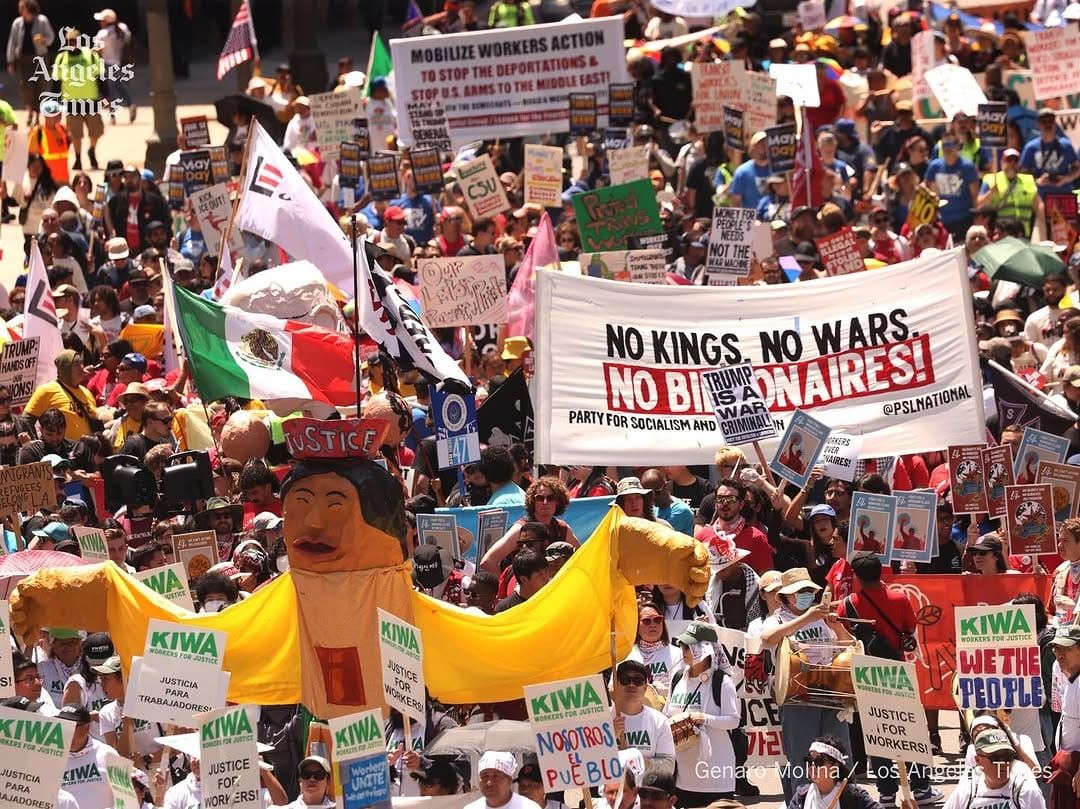
Thursday happened. Over 4,000 demonstrations were held across the United States under the May Day Strong banner. In Los Angeles alone, over 120 organizations and unions endorsed the march, a level of coalition support organizers said they hadn’t seen in a very long time. Thousands marched from MacArthur Park to City Hall through immigrant communities that have spent the past year living under the weight of federal enforcement. Nationally, over 500 labor unions, student groups, and community organizations participated. The crowd was real. The energy was real. The coalition was the broadest it has been in years.
The administration dismissed it before the marches ended.
That gap, between the size of what Thursday produced and the absence of any institutional response to it, is the thing worth sitting with this Monday morning. Not because Thursday failed. It didn’t. But because the movement’s own organizers have been explicit that Thursday was preparation for something bigger, and preparation only works if you evaluate it honestly.
What Thursday Actually Produced
The Coalition Held
The first thing Thursday proved is that the organizational infrastructure built through No Kings, the Minnesota economic blackouts, and months of local coalition work can be directed toward a coordinated national day of action and hold. The coordinator of the Los Angeles May Day Coalition attributed the coalition’s breadth directly to the federal government’s own actions, saying the July presence of immigration agents in SWAT gear and armored vehicles at MacArthur Park laid the foundation for the high turnout. That is a structural observation worth keeping: the government’s choice of tactics created the coalition that showed up Thursday. The enforcement did the organizing work.
In North Carolina, nearly 20 public school districts closed due to anticipated staff absences, and the Charlotte-Mecklenburg Board of Education called an optional teacher workday. That is not a symbolic gesture. That is an institution making a calculation that the workforce disruption was real enough to respond to structurally rather than ride out. Airport workers in Boston and San Francisco demonstrated alongside education workers, nurses, and immigrant rights organizers under a shared banner. The breadth of sectors represented on Thursday is exactly what a 2028 general strike requires as its foundation.
The Economic Blackout Question
The harder question is what the No Work No School No Shopping economic blackout actually produced in measurable terms. The reporting is thin on this, and the thinness is itself a data point. Crowds are countable. Economic disruption is harder to quantify and easier to dismiss, and the absence of clear disruption metrics by Friday afternoon means the administration’s ability to characterize Thursday as a march rather than a strike is largely unchallenged in the public record.
A Goldman Sachs report published earlier this month found that AI has wiped out an average of 16,000 jobs per month over the past year, and that figure was being cited by demonstrators across the country as evidence of what the economic blackout was responding to. The argument for economic withdrawal is strongest when the economic harm being protested is concrete and documented. That documentation exists. What Thursday still needs to develop is the capacity to translate that argument into disruption that the institutions being protested actually feel.
MacArthur Park as Ground
The SEIU-United Service Workers West president told the crowd at MacArthur Park: “We are here to say loudly and clearly that we are not afraid. We will not be silenced. We must keep fighting against the authoritarian in the White House, and stand up against the corporations and their greed.” That is the register of the moment, defiant, clear, and grounded in a specific community’s specific experience of federal power. The choice to anchor the LA march at MacArthur Park, a site the federal government used last July to stage immigration enforcement operations while children played in the park, is not rhetorical. It is a territorial claim. We are still here. This is still our ground.
The march theme, “Solo el Pueblo Shuts It Down,” carried the 20th anniversary of La Gran Marcha, the 2006 mobilization that drew more than 500,000 people through downtown Los Angeles in what remains the largest single-day public demonstration in the city’s history. Thursday was explicitly connecting itself to that lineage. Whether it is building toward something of comparable scale is the question 2026 and 2027 will have to answer.
What Thursday Didn’t Prove
The Gap Between the Claim and the Test
The May Day Strong coalition framed Thursday as a general strike. By the strict definition, it was not. A general strike requires sustained work stoppages across multiple major industries that impose costs large enough to force the institutions being challenged to negotiate. What Thursday produced was the largest coordinated day of labor and community action in years, with real institutional participation and genuine economic disruption in specific sectors and specific cities, but without the scale or duration that qualifies as a general strike in the historical sense.
That distinction matters for one reason: the movement’s opponents will use the gap between the claim and the reality to argue that the organizing capacity is smaller than it appears. That argument is wrong on the evidence, but it is available, and it will be made. The more honest and strategically sound framing, the one that actually serves the 2028 goal, is the one the movement’s own best organizers have been using privately: Thursday was a rehearsal. The standard is not whether it stopped the economy. The standard is whether it built the muscle.
What the Morning After the March Didn’t Change
Congress passed the Homeland Security funding bill that included $70 billion for immigration enforcement the same week as the march. Republicans voted on the budgetary measure that would fund ICE under the Department of Homeland Security while demonstrations were being organized across the country. The administration issued a statement characterizing May Day as a celebration of MAGA workers and their role in electing the president. No policy shifted. No negotiation opened. No institutional response acknowledged the scale of what happened in the streets.
This is not a failure unique to Thursday. It is the condition the movement is operating in. The institutions being protested have made a consistent calculation that they can absorb street-level dissent without changing their behavior, and that calculation has been correct so far. The only thing that changes it is economic disruption at a scale that imposes costs they cannot absorb, which is exactly what Shawn Fain’s 2028 architecture is designed to produce.
ROOT: Why One Day Has Never Been Enough
The historical record on mass days of action is consistent and worth naming directly. The 1886 general strike for the eight-hour day built momentum across years before May 1st became its focal point, and even then, the eight-hour workday did not arrive until 1938. The 2006 Day Without an Immigrant, which drew half a million people through downtown Los Angeles alone, produced no immediate legislative response to the bill it was protesting. The George Floyd uprising of 2020, which generated the largest protest movement in American history by some measures, produced a wave of symbolic institutional responses and almost no durable structural change in policing.
Mass mobilizations matter. They shift public consciousness, build organizational infrastructure, and demonstrate the size and breadth of a movement to its own participants, which is itself a form of power. What they have historically not done, on their own, is force institutional change. That has required sustained economic pressure, legal strategy, and the kind of coordinated power that takes years to build. Thursday was one day in what has to be a multi-year campaign if it is going to produce anything the institutions being challenged will actually feel.
What Comes Next
THE GAP
The gap between what Thursday produced and what 2028 requires is not a reason for discouragement. It is a design specification. The DSA’s National Labor Commission has been explicit that May Day 2026 is preparation for May Day 2027, which is preparation for May Day 2028, with each iteration stress-testing the organizational infrastructure and expanding the coalition’s capacity for economic disruption. The machinery being built, the coalitions, the toolkits, the aligned contract expirations, the shared demands, signals that what begins on May Day will not end there.
The specific gaps Thursday revealed are measurable and addressable. The economic blackout needs better metrics and better infrastructure for documenting disruption in real time, so that the movement controls the story of what happened rather than ceding that ground to a dismissive administration. The coalition needs to convert Thursday’s turnout into ongoing organizational relationships rather than letting the energy dissipate between annual mobilizations. And the financial infrastructure, which the Union Now strike fund is beginning to build, needs to be developed enough by 2028 to sustain the duration that a genuine general strike requires.
WHO PROFITS from the Gap Between the March and the Strike
The institutions that benefit most from keeping mass labor mobilizations in the category of political expression rather than economic disruption are not subtle about their strategy. Management-side law firms published detailed employer guides to May Day before Thursday arrived, advising on how to document worker participation for potential disciplinary purposes, how to enforce no-strike clauses in existing contracts, and how to characterize political walkouts as unprotected activity under the NLRA. The legal architecture of American labor law was designed, in part, to ensure that exactly the kind of coordinated economic action May Day Strong is attempting remains legally complicated and financially risky for individual workers.
That architecture is the reason a centralized strike fund matters. That architecture is the reason contract alignment matters. That architecture is the reason the 2028 target is five years out rather than next month. The people who profit from keeping workers in the street rather than off the job understand the difference between a march and a strike better than most of the commentary about Thursday does. The question is whether the movement does too.
The 2028 Clock
UAW president Shawn Fain has been direct: “A general strike isn’t going to happen on a whim. It’s not going to happen over social media. A successful general strike is going to take time, mass coordination, and a whole lot of work by the labor movement.” Thursday was that work. Not the culmination of it. The work.
The UAW’s contracts expire at midnight on April 30, 2028. The AFT’s 1.8 million members have passed a resolution aligning their contract expirations to the same date. The Chicago Teachers Union, the American Postal Workers Union, and a growing list of unions have publicly supported the effort. The Union Now strike fund launched three weeks ago to address the financial asymmetry that has historically let employers wait out strikes that workers cannot sustain. The legal strategies are being developed. The coalition infrastructure is being stress-tested in real time.
May Day 2026 was Thursday. May Day 2027 is 361 days away. The revolution has a deadline. It is April 30, 2028, at midnight. Thursday told us the people are ready. The next two years will tell us whether the infrastructure is.
FURTHER READING
What the LA coalition built and who showed up
ABC7 Los Angeles — May Day: Thousands participate in rally, march from MacArthur Park to DTLA
The ground-level account of Thursday in Los Angeles, including the coalition breadth and the speakers at MacArthur Park.
The national picture and the AI displacement context
Al Jazeera — May Day rallies sweep US, demanding reforms for working-class rights
The broadest single-source account of Thursday’s national scope, including the Goldman Sachs AI jobs data cited by demonstrators.
The 2028 architecture in Fain’s own words
In These Times — May Day 2028 Could Transform the Labor Movement—and the World
The UAW president’s direct statement of what the contract alignment is designed to produce and why the timeline is five years, not one.
The labor history Thursday was standing in
Economic Policy Institute — May Day then and now: The ongoing fight for workers’ rights
The 140-year arc from Haymarket to Thursday, with the structural context for why one day has never been enough on its own.
The employer’s playbook for responding to Thursday
Fisher Phillips — Will Your Workers Walk Out on May 1?
Read this to understand exactly what management-side firms told employers to do before, during, and after Thursday, because it reveals what they are actually afraid of and what they are not.
Our Revolution Media is an independent publication covering labor, power, and political economy from East LA. Subscribe at ourrevolution.media.