A Wealth Tax Needed Two Thirds. Proposition 40 Needs a Majority.
Two bills asked 120 legislators for a wealth tax and got nothing. Proposition 40 asks 22 million voters for a simple majority instead.

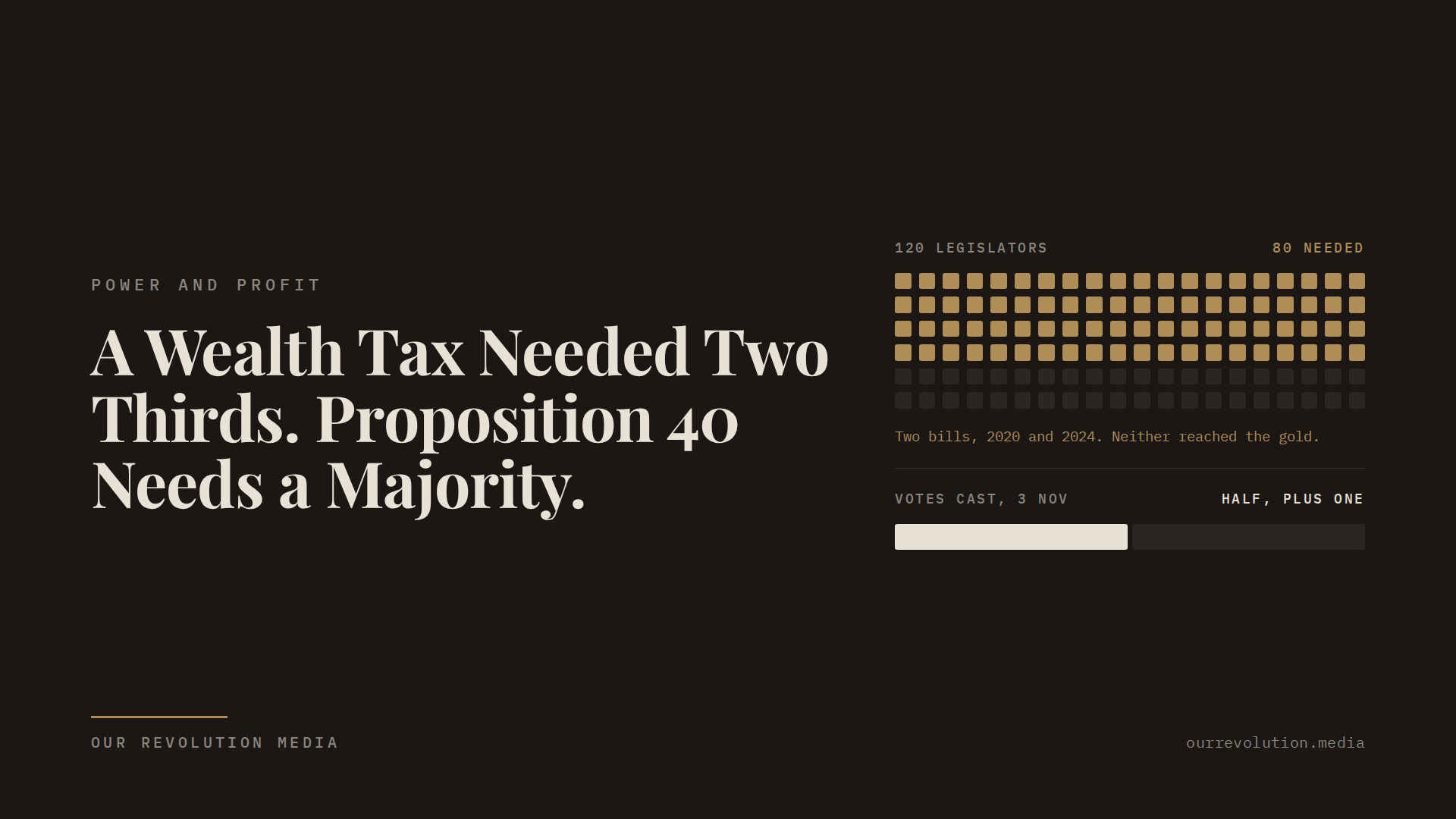
California's legislature killed a billionaire wealth tax twice, in 2020 and again in 2024, because raising one by statute needs two thirds of both chambers. Proposition 40 skips the Legislature and goes to voters instead, as a constitutional amendment that needs only a simple majority. The state's own fiscal analyst has measured the trade, tens of billions in one time revenue against a smaller but permanent ongoing loss if enough of California's few hundred billionaires leave.
Amid a Democratic clash between two of its highest profile advocates, the push to tax California's billionaires has qualified for the ballot, requiring nothing further from Sacramento.
That single fact, that the state legislature is no longer between this tax and the people it would reach, is the story the week's loudest coverage never got to. On 17 August 2026, Mark Cuban spent a weekend on social media telling Representative Ro Khanna he did not understand business, over Khanna's proposal to let illiquid startup founders pay the tax with a nonrecourse loan against pledged shares. Cuban called the loan idea pointless, warned California would end up owning stakes in private companies, and closed with a threat to move his own investment elsewhere. Fox Business ran it as a personal confrontation, "Mark Cuban tells Ro Khanna you don't understand business, threatens investment shift over billionaire tax." https://www.foxbusiness.com/politics/mark-cuban-tells-ro-khanna-you-dont-understand-business-threatens-investment-shift-over-billionaire-tax Eight stories matched the same search terms in the Media Cloud corpus over the trailing week, essentially all of it clustered around the same fight.
The fight is documented and it is also beside the point. Proposition 40 is not on the November ballot because Cuban lost an argument or because Khanna won one. It is there because two earlier attempts to do the same thing by ordinary statute both failed for the same structural reason, and the people behind this measure built around that reason rather than repeating it.
THE GAP
What the Text Actually Taxes
Proposition 40, filed with the Attorney General and given its title and summary on 26 December 2025 under proponent Suzanne Jimenez, imposes a one time tax equal to 5 percent of net worth on California residents whose worldwide assets exceeded 1 billion dollars as of 1 January 2026, due in 2027. Covered wealth includes businesses, securities, art, collectibles and intellectual property. Real property and some retirement accounts are excluded. Ninety percent of what it raises is constitutionally earmarked for public health care services, the remainder split between food assistance, education and administration of the tax itself. https://oag.ca.gov/system/files/initiatives/pdfs/25-0024A1%20%28Billionaire%20Tax%20%29.pdf
The Legislative Analyst's Office puts the number of people this reaches at a few hundred, all of California's resident billionaires and no one else. https://lao.ca.gov/BallotAnalysis/Initiative/2025-024 On 17 June 2026 the Secretary of State announced the measure had exceeded the signature threshold, 874,641 valid signatures, 8 percent of the votes cast for governor in 2022, through random sample projection, with certification following on 25 June and a slot on the 3 November 2026 General Election ballot as Proposition 40. https://www.sos.ca.gov/administration/news-releases-and-advisories/2026-news-releases-and-advisories/california-secretary-state-shirley-n-weber-phd-announces-new-measure-eligible-november-2026-general-election-ballot-imposes-one
The Honest Version
The Legislative Analyst's own fiscal finding is two sided, and a piece that uses only its top line number is not being honest about what the state's own analyst wrote. The state would probably collect tens of billions of dollars, the office says, spread across several years starting in 2027, the exact figure very hard to predict because it depends on the wealth of a few hundred specific people at a specific moment. https://lao.ca.gov/BallotAnalysis/Initiative/2025-024 The same document names the countervailing risk in the same breath. It is likely, the LAO writes, that some billionaires decide to leave California in response, and that outmigration would produce an ongoing decrease in state income tax revenues of hundreds of millions of dollars or more per year, a loss that is permanent where the wealth tax's money is one time. Khanna's loan proposal, which Cuban dismissed as revenue neutral by construction since the state would lend the money it then collects back as tax, has not been scored by the LAO at all, so its effect on either number is not something this piece can state. Both figures in the LAO's own analysis are material, both are measured by the same office, and a version of this piece that reports only the tens of billions is a weaker piece than the one the state's own analyst wrote.
ROOT
Two Bills, One Wall, Four Years Apart
This is not the first attempt. Assembly Bill 2088, introduced in 2020, would have taxed California resident worldwide net worth above 30,000,000 dollars annually at 0.4 percent, with a declining tail that continued to reach a person for several years after they left the state. It died 30 November 2020, from committee without further action, at the close of the two year session, having never reached a floor vote. https://leginfo.legislature.ca.gov/faces/billStatusClient.xhtml?bill_id=201920200AB2088
Assembly Bill 259, introduced in 2023 by Assemblymember Alex Lee, would have taxed net worth above 50,000,000 dollars annually at 1 percent, rising to a combined 1.5 percent above 1,000,000,000 dollars. It died 31 January 2024, held under submission in the Assembly Revenue and Taxation Committee's suspense file. https://leginfo.legislature.ca.gov/faces/billStatusClient.xhtml?bill_id=202320240AB259 AB 259 could not stand alone. It was written to take effect only if voters first approved a companion constitutional amendment, ACA 3, because Article XIII, Section 2 of the California Constitution caps the tax rate on the personal property it defines, notes, shares of stock, bonds, solvent credits, at four tenths of one percent of full value, a ceiling neither bill's rate could fit under as an ordinary statute. ACA 3 needed a two thirds vote in each house just to reach the ballot it was meant to put the question on, and it never got one. https://leginfo.legislature.ca.gov/faces/billTextClient.xhtml?bill_id=202320240ACA3
Both bills died in the same room for the same reason. A statute that raises a tax needs two thirds of the Legislature under Article XIII A, and a constitutional amendment referred by the Legislature needs the same two thirds just to be offered to voters. Proposition 40 uses neither path. As an initiative constitutional amendment, it goes directly to the ballot on signatures, 874,641 of them, and becomes law on a simple majority of votes cast, the same threshold that failed to assemble twice among 120 legislators, asked instead of 22 million registered voters. That arithmetic, not Cuban's feed or Khanna's, is the mechanism the coverage missed.
What Happened Everywhere Else It Was Tried
The international record cuts in both directions, and a ROOT section that reports only the direction favorable to the measure is not this series.
France repealed its general wealth tax. The impot de solidarite sur la fortune, reestablished in 1989, was abolished effective 1 January 2018 by Article 31 of that year's finance law and replaced with a narrower tax reaching only real property, roughly halving the number of households that owed anything. https://www.legifrance.gouv.fr/jorf/article_jo/JORFARTI000036339239
Norway raised its wealth tax and kept it. The 2022 state budget lifted the combined municipal and state rate to 0.95 percent above 1,700,000 kroner and 1.1 percent above 20,000,000 kroner, confirmed directly against the Norwegian Tax Administration's own historical rate table. https://www.skatteetaten.no/en/rates/wealth-tax/?year=2022 Reuters, in an analysis published 24 November 2025, reports high wealth residents relocating in the two years that followed, most visibly to Switzerland. Civita, a conservative research foundation, counts 261 residents with assets above 10 million kroner leaving in 2022 and 254 in 2023, more than double the rate before the increase, and the business magazine Kapital finds 105 of its 400 wealthiest Norwegians now living abroad or having transferred wealth to relatives who do. Those counts come from Civita and Kapital, not from the finance ministry and not from the statistics office. https://www.bnnbloomberg.ca/business/2025/11/24/norways-lesson-for-europe-on-wealth-taxes-let-some-millionaires-go/ Neither count can be confirmed against official emigration statistics, because Statistics Norway does not publish one. Its emigration tables break down by citizenship, country, sex, age, marital status and region, and by nothing financial at all, so a count of wealthy people leaving comes from linked tax register work rather than from the migration series, and it should be described that way rather than as an official count.
The register work cuts the other way, and a piece that leans on the departure counts without it is quoting one side. Iacono and Smedsvik, CESifo Working Paper 11335 (2024), working from Statistics Norway third party wealth data, find that wealth tax payers were between 1.83 and 3.3 percent of everyone who emigrated from Norway in each year from 2015 to 2022, against about 10 percent of the adult population, which is the opposite of the pattern the relocation stories imply. https://www.ifo.de/en/cesifo/publications/2024/working-paper/behavioral-responses-wealth-taxation-evidence-norwegian-reform
Revenue is checkable, and it rose. Statistics Norway records assessed wealth tax of 18,454 million kroner for income year 2021, the year before the increase, then 26,320 million for 2022, 29,399 million for 2023 and 31,784 million for 2024. The series ends at 2024 and was last updated on 9 January 2026, so there is no 2025 outturn to set against 2022 yet, and any 2025 number in circulation is an estimate rather than a result. https://www.ssb.no/en/statbank/table/08815
Spain built a national solidarity tax on top of its existing regional one. Ley 38/2022, in force from 28 December 2022, taxes net worth above 3,000,000 euros at rates from 1.7 to 3.5 percent, written into law as temporary for two tax years. https://www.boe.es/buscar/doc.php?id=BOE-A-2022-22684 It has not expired. Disposicion adicional quinta, apartado 2 of Real Decreto ley 8/2023 extends it for as long as the review of wealth taxation in the context of the reform of the regional financing system has not taken place, wording carried in the Boletin Oficial del Estado's own consolidated note to article 3 of Ley 38/2022. That is open ended and conditional rather than permanent, and the tax is still called temporary in its own name, which is the shape a California measure would have to choose between. https://www.boe.es/buscar/act.php?id=BOE-A-2022-22684
The clearest counterweight sits in American constitutional law rather than in another country's statute book. In Moore v. United States, decided 20 June 2024, the Supreme Court upheld a one time tax on undistributed foreign corporate earnings, attributed to American shareholders and taxed as their realized income, and pointedly declined to decide whether the Sixteenth Amendment requires realization for Congress to tax income at all. Justice Barrett's concurrence in the judgment, joined by Justice Alito, went further than the majority needed to and warned that a tax on the value of a person's assets at a single point in time would be a quintessential tax on property, the kind the Constitution's Direct Tax Clause requires Congress to apportion among the states by population, which none of the federal wealth tax proposals in circulation do. Justices Thomas and Gorsuch dissented on the same clause from the other direction, arguing the repatriation tax itself already crossed that line. https://www.law.cornell.edu/supremecourt/text/22-800_2024-06-20 None of that binds Proposition 40. The Direct Tax Clause restrains Congress, not a state amending its own constitution by popular vote, which is exactly the maneuver AB 259 needed and never got. But no court has yet tested a wealth tax shaped like this one, at the state level, enacted this way, and Moore is the clearest sign of how skeptical a bench already primed to distrust an untested tax on wealth would be if one like it ever reached it by another route.
THE COUNTER MECHANISM
Proposition 40 is decided 3 November 2026, a dated, statewide vote with no ambiguity about when it closes. The deadline to register beforehand is 19 October 2026, per the Secretary of State's own election page. https://www.sos.ca.gov/elections/upcoming-elections/general-election-november-3-2026 Registration status can be checked and updated at https://registertovote.ca.gov, and the Legislative Analyst's full fiscal analysis, both sides of it, is posted at https://lao.ca.gov/BallotAnalysis/Initiative/2025-024 for anyone deciding how to vote rather than which post to like.
At the Reader's Scale
A measure that skips the Legislature is decided by who actually turns up, and whether a neighbourhood turns up is partly a staffing question. Los Angeles County recruits Community Election Workers to run its vote centers, and the county's own eligibility page sets the bar lower than most people assume: 18 or older, and either a United States citizen registered to vote in California or a Legal Permanent Resident. Permanent residents who cannot vote on Proposition 40 can still staff the place where their neighbours do. https://www.lavote.gov/home/voting-elections/pollworker-information/become-an-election-worker/community-election-workers
The work is paid and the county says so on the same page, 100 dollars for each day served, 80 dollars for completing training, and a further 100 dollar stipend for workers who speak one of the qualified languages. Spanish is on that list, along with Armenian, Chinese, Khmer, Korean, Tagalog, Vietnamese and fifteen others. A vote center in a neighbourhood where the ballot is being read in a second language is staffed by whoever applied, and applications close when the county has filled the shifts rather than on a date it publishes.
Two bills asked 120 legislators for a supermajority and got neither. This measure asks a much larger and much less capturable body for a plurality of one. Whether that arithmetic is enough was never a question Cuban or Khanna got to answer by themselves. On 3 November, California's voters answer it for them, and on the same day some of those voters are the ones handing out the ballots.
Further Reading
California Attorney General, the billionaire tax initiative's title and summary issued 26 December 2025, and full text. https://oag.ca.gov/system/files/initiatives/pdfs/25-0024A1%20%28Billionaire%20Tax%20%29.pdf
Legislative Analyst's Office, fiscal analysis of the wealth tax initiative. https://lao.ca.gov/BallotAnalysis/Initiative/2025-024
California Secretary of State, announcement of ballot qualification, 17 June 2026. https://www.sos.ca.gov/administration/news-releases-and-advisories/2026-news-releases-and-advisories/california-secretary-state-shirley-n-weber-phd-announces-new-measure-eligible-november-2026-general-election-ballot-imposes-one
California Secretary of State, November 3, 2026 General Election page, registration deadlines. https://www.sos.ca.gov/elections/upcoming-elections/general-election-november-3-2026
AB 2088 (2019 to 2020 Regular Session), bill status. https://leginfo.legislature.ca.gov/faces/billStatusClient.xhtml?bill_id=201920200AB2088
AB 259 and ACA 3 (2023 to 2024 Regular Session), bill status and text. https://leginfo.legislature.ca.gov/faces/billStatusClient.xhtml?bill_id=202320240AB259 https://leginfo.legislature.ca.gov/faces/billTextClient.xhtml?bill_id=202320240ACA3
Loi n. 2017-1837 du 30 decembre 2017 de finances pour 2018, Article 31. https://www.legifrance.gouv.fr/jorf/article_jo/JORFARTI000036339239
Skatteetaten, Norwegian wealth tax rates by year. https://www.skatteetaten.no/en/rates/wealth-tax/?year=2022
Ley 38/2022, de 27 de diciembre, Boletin Oficial del Estado. https://www.boe.es/buscar/doc.php?id=BOE-A-2022-22684
Ley 38/2022, consolidated text, carrying the note on the extension by Real Decreto ley 8/2023. https://www.boe.es/buscar/act.php?id=BOE-A-2022-22684
Statistics Norway, table 08815, taxable wealth, debt and wealth tax by tax components. https://www.ssb.no/en/statbank/table/08815
Moore v. United States, 602 U.S. 572 (2024). https://www.law.cornell.edu/supremecourt/text/22-800_2024-06-20
Fox Business, Mark Cuban and Ro Khanna exchange over the billionaire tax, 17 August 2026. https://www.foxbusiness.com/politics/mark-cuban-tells-ro-khanna-you-dont-understand-business-threatens-investment-shift-over-billionaire-tax
Our Revolution Media is an independent publication covering labor, power, and political economy from East LA.