Federal Antitrust Review Ended in June. Paramount Wants State Review to Cost 1.88 Billion Dollars.
Federal review of the Paramount Warner Bros. Discovery merger ended in June with no conditions. Paramount's answer to the states who sued anyway was that suing should cost 1.88 billion dollars. Three days before the hearing, the states settled. Corrected 22 September.

CORRECTION, 22 SEPTEMBER 2026. This piece published at 6am today with the bond motion described as live and the hearing set for 24 September. On 21 September, the day before, the twelve states, Paramount and Warner Bros. jointly asked the court to enter a consent decree, let the merger close, and vacate that hearing (Dkt. 243). The docket entry was in this publication's own records before publication and was not read in time. The piece has been revised to say so; the argument about the mechanism stands. Corrections go to letters@ourrevolution.media.
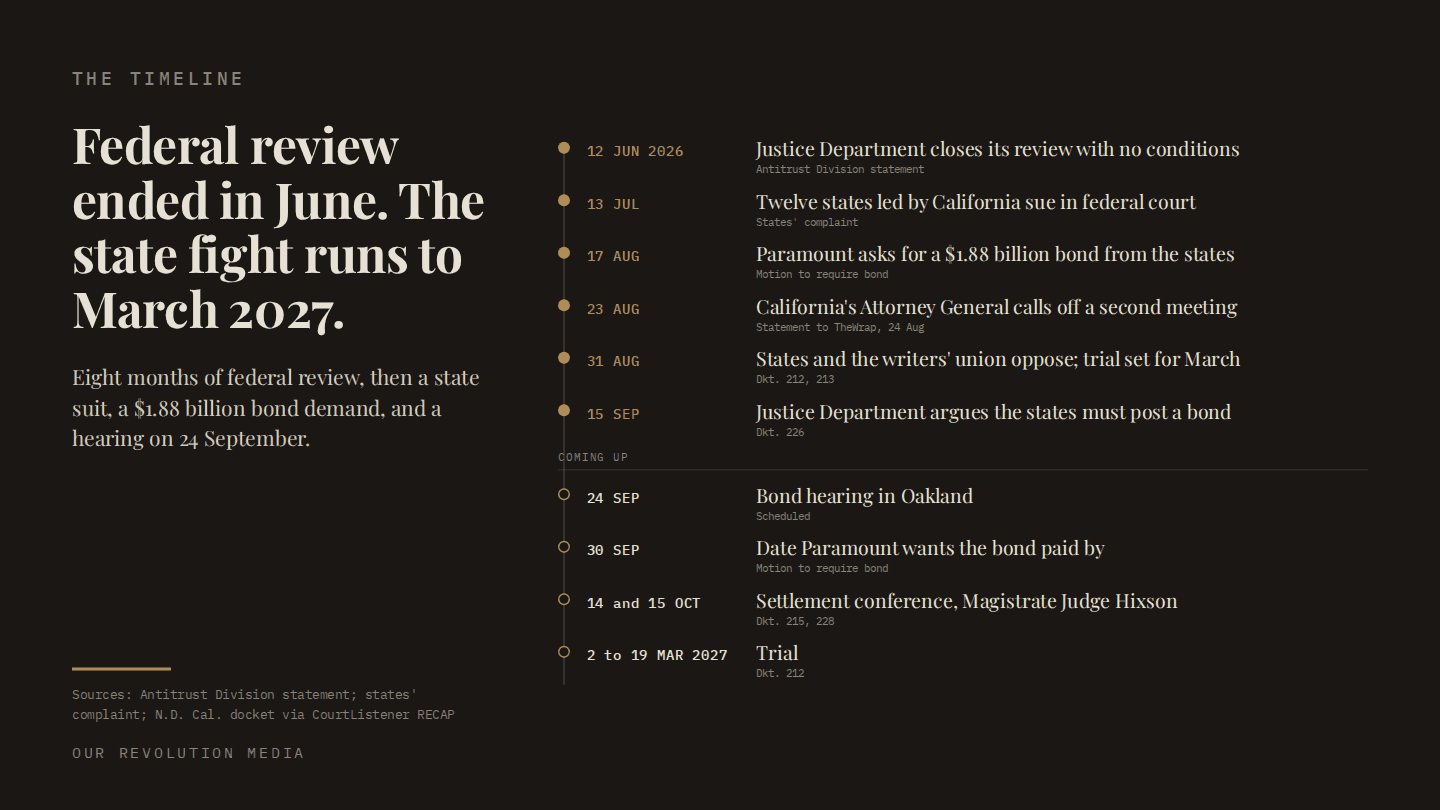
The Justice Department closed its investigation of the Paramount Warner Bros. Discovery merger on 12 June 2026, after eight months and more than two million documents, without asking for a single condition. Twelve states led by California sued five weeks later under the same Clayton Act, the check federal clearance was never built to close. Paramount's answer, filed 17 August, does not ask a court to let the merger through. It asks the court to make suing over it cost 1.88 billion dollars, due by 30 September, before a single fact has been tried. That is where the fight stood until 21 September, the day before this piece published, when the twelve states, Paramount and Warner Bros. jointly asked the court to enter a consent decree, let the deal close, and cancel the bond hearing. The price was never set. What the states took instead is the last section of this piece.
A federal antitrust clearance ends one review. It was never built to end all of them. On 27 February 2026, Paramount Skydance Corporation agreed to acquire Warner Bros. Discovery for 31 dollars a share, about 110 billion dollars, the largest media merger in Hollywood history. The Justice Department's Antitrust Division closed its own investigation on 12 June, after what it called a rigorous eight month review of more than two million documents from over 80 custodians, and found no likely harm to streaming, linear television or theatrical film markets. By 14 August, Paramount said regulators representing nearly 70 countries had cleared the deal. Twelve states led by California filed their own suit on 13 July, in the Northern District of California, under Section 16 of the Clayton Act, to enjoin what they call a violation of Section 7.
Coverage of what happened next, Paramount's 17 August motion asking the court to require the states to post that 1.88 billion dollar bond, has mostly run it as a standoff story, states call it a threat, Paramount calls it the law. That frame treats the bond fight as noise attached to a merger that is basically decided. On the merits it never was. Federal review ended in June. State enforcement is structurally independent of it, and the bond motion was a test of whether that independence survives being priced. The test was called off before the answer.
THE GAP
The Review That Closed in June
The Antitrust Division's statement is precise about what it did and did not find. Over eight months, the Division analyzed three markets, streaming video on demand, linear television, and the development, production and distribution of theatrical films, and determined the merger was not likely to harm competition or consumers in any of them. State attorney general offices participated in that investigation too, through Paramount and Warner Bros.'s own waivers of confidentiality, which let the states see the Division's evidence and sit in on its depositions. The states were not locked out of the federal record. They read it and sued anyway, which is a different claim than the trade coverage's shorthand that the states are relitigating a settled question. The Division's statement also names the deal's specific history, Netflix agreed to acquire Warner Bros. Discovery in December 2025, Paramount responded with a competing all cash tender offer, and the Division evaluated both bids before either closed its file on either.
Paramount's own count of international clearances, cited in its bond motion, is nearly 70 countries by 14 August, including the United Kingdom's Competition and Markets Authority on 6 August. Every one of those clearances is a separate legal proceeding under a separate country's law, and none of them is the twelve state suit still open in Oakland.
Three Markets, One Buyer
The states' complaint identifies three relevant markets and argues the merger is presumptively illegal in each of them under the federal merger guidelines' concentration thresholds. In the distribution of wide release theatrical films, the merger would raise the Herfindahl Hirschman Index by 359 points to 2,074. In the distribution of anticipated top grossing theatrical films, it would raise the index by 445 points to 2,427. In the licensing of basic cable channels to distributors, by 321 points to 2,007. A merger that raises a market's index by more than 100 points to a level above 1,800 is presumed anticompetitive under the joint merger guidelines the complaint cites, and all three markets clear that bar by three to four times over.
The complaint names who is on the other side of those numbers. Movie theatres negotiate directly with Paramount and Warner Bros. over box office splits, minimum ticket prices and exclusivity windows, and the complaint says a combined studio, one of only four left distributing wide release films instead of five, gains leverage a theatre cannot route around. Cable and satellite distributors negotiate separately for the right to carry CNN, Nickelodeon, HGTV, TNT and dozens of other channels, and the complaint says the combined company, controlling more than a quarter of all major basic cable channels by revenue, would be positioned to raise the affiliate fees distributors pay, fees the complaint says get passed to subscribers' monthly bills. A third group is a plaintiff in its own right rather than a named example. Writers Guild of America, West and East sued Paramount the day after the states did, in a separate case before the same judge, arguing the same consolidation that threatens theatres and cable distributors also threatens the market for the writers' own labor, fewer buyers for scripts and fewer competing production slates. The two cases were later procedurally joined under the same no close order, and the WGA's own request for a preliminary injunction was withdrawn in favor of it, but the union's suit against Paramount, case 4:26 cv 07212, remains open.
The Honest Version
Paramount has a textual argument that is not frivolous. Section 16 of the Clayton Act, the same provision the states invoke to sue, conditions preliminary injunctive relief on the plaintiff executing a proper bond against damages from an injunction improvidently granted, and Federal Rule of Civil Procedure 65 says something similar for injunctions generally. That requirement exists in the statute's own text, not as a defense tactic invented for this case. Whether the stipulated order not to close, agreed to by the parties rather than imposed after a contested hearing, counts as the kind of injunction that provision covers is a live legal question, not a settled one, and it was the specific question set for the 24 September hearing. The court will not decide it. The joint motion filed 21 September asks the court to vacate that hearing, so whether a stipulated no close order carries a bond stays open for the next state that signs one.
It is also true that the 6.97 million dollar daily fee Paramount says it owes Warner Bros. shareholders for every day past 1 October the deal stays closed is a fee Paramount and Warner Bros. wrote into their own merger agreement, before either state opposition or a bond motion existed. The states' and the union's opposition, filed 31 August, makes exactly that point. Paramount, it says, "seeks to extract $1.88 billion from the public and a nonprofit labor union to underwrite the costs of two private contracts it entered willfully, with advice of counsel, and for its own benefit," and "whatever regret Paramount may feel for its commitments to Warner Bros., to Plaintiff States, to the WGA, and to the Court, it cannot show that the Court acted 'improvidently' in signing the joint stipulation." Granting the request, the states add, "would incentivize merging parties to negotiate extraordinary fees to inoculate themselves from state and private antitrust enforcement." If the court requires any bond at all, the brief asks for "a nominal bond of $10,000."
ROOT
The Day After Clearance Is Not New
States suing over a merger the day after a federal regulator closed its own file has a direct precedent, and it went to the Supreme Court. California sued the day after the Federal Trade Commission gave final approval to a consent order settling the FTC's own challenge to a different supermarket merger, seeking the fuller remedy of divestiture the FTC's settlement had not required, in California v. American Stores Co., where the Ninth Circuit had held Section 16 of the Clayton Act does not reach that far, that divestiture is not available relief in a private or state suit under that section, before the Supreme Court unanimously reversed on 30 April 1990. Divestiture is injunctive relief within the meaning of Section 16, Justice Stevens wrote for the Court, and a state's suit under that section is not foreclosed by a federal settlement that resolved less than the state wanted. Justice Kennedy's concurrence is the honest counterweight on the record, not supplied by hindsight. He warned that allowing states and private plaintiffs to sue for more after a negotiated federal settlement could reduce the federal government's own negotiating leverage and undercut the predictability Congress built into the premerger notification process, the identical objection a defendant raises whenever a state proceeds after its own federal regulator has already cleared a deal.
Persistence Without a Guarantee
The pattern repeated after Microsoft's antitrust case, and the honest version of that history cuts against overselling what a state suit delivers. When the Department of Justice and nine states settled antitrust claims against Microsoft in 2001, nine other states, led by New York and including California, declined to join and continued litigating for a broader remedy, including a possible breakup. They got a 32 day remedy trial. On 1 November 2002, the district court adopted a lightly modified version of the federal settlement and rejected nearly all of the additional remedies the non settling states had asked for. Continuing past a federal settlement bought those states a public trial record and little else. That is the honest counterweight to citing state persistence as a reliable check on a merger federal regulators have already cleared, and it is also why a mechanism that makes persistence itself prohibitively expensive matters more than the merits of any one case. A state that might lose the fight New York fought in 2002 can still choose to have it. A state priced out of the courtroom cannot.
THE COUNTER MECHANISM
The bond motion is on a public docket with dates already set. The states' opposition was filed 31 August 2026, arguing that Paramount is trying to shift onto the states a cost the companies wrote into their own merger agreement, and Paramount's reply, filed on the 8 September deadline, repeated the demand and cast the suit as "seeking to stymie the transaction while immunizing themselves from economic accountability if Paramount prevails." Then, on 15 September, nine days before the hearing, the federal government came back into the case it had closed in June. The Antitrust Division filed a Statement of Interest that "takes no position on whether the Stipulation and Order Not to Close (Dkt. No. 169) is, in fact, a preliminary injunction, or whether defendants waived their right to request a bond in this matter," and then argues the question that matters most to the states: "States and private parties must post a proper bond before a preliminary injunction may issue under Section 16 of the Clayton Act." Its stated interest is the correct application of Section 16, and it reads the states' fallback of a nominal bond as leaving a private plaintiff "in essentially the exact same position as the federal government under Section 15," a position the statute reserves for the government alone. The agency that found no likely harm in any of three markets is not arguing the merits here. It is arguing that the states' right to keep going should carry the price Congress attached to it. The Attorney General's office put its position in one sentence to The Center Square: "Our office believes Paramount's motion has no merit, and we look forward to presenting our case in court at the September 24th hearing." The hearing, originally set for 21 September, was continued at the 19 August case management conference to 24 September before Judge Araceli Martinez Olguin in Oakland. It will not happen if the court grants what the parties filed on 21 September. Trial is set by the court's 31 August scheduling order for 2 to 19 March 2027, well before the 1 June 2027 outside date the July stipulation set for how long the deal can be held open without a ruling. One more date sits a day past the hearing: on 9 September the Supreme Court gave California and the other eleven states until 25 September to answer Iowa and Montana's motion for leave to file a bill of complaint, which asks that Court to enjoin the states' suit as politicized and decide the merger itself.
Between those dates the parties tried to talk, and it did not hold. On Thursday 20 August the California Attorney General told CNBC that settling the case would require "robust structural remedies." His office met Paramount on Friday 21 August, and a second meeting was set for Monday 24 August. Over the weekend the Wall Street Journal reported what California would ask for, separate ownership of the studios and the sale of cable channels, and late Sunday he pulled the Monday meeting. His statement on 24 August, given to TheWrap, is his own account of the sequence: "My office had a meeting with Paramount on Friday. Paramount did not maintain the confidentiality of that meeting. Not only did Paramount leak the alleged substance of settlement discussions, but they misrepresented these discussions, demonstrating a lack of good faith. As soon as Paramount stops playing games and engages sincerely, my office is happy to meet again." Paramount said the same day that it had not been the source of the leaks and stood "ready to continue good faith discussions." On 2 September it referred the case to Magistrate Judge Thomas Hixson for settlement and set a conference for 14 and 15 October in San Francisco. The parties did not wait for it.
That sequence belongs next to the bond motion rather than in a separate story about deal news, because it is the same question asked twice. A state that can walk away from a settlement table is a state whose enforcement is not yet purchasable. A state facing a 1.88 billion dollar bond before it has tried a single fact may not be able to walk away the next time, and that is what the motion is for.
The Price Was Never Set
On 21 September, three days before the hearing, the twelve states, Paramount and Warner Bros. filed a joint motion asking the court to enter a proposed consent decree as a final judgment, dissolve the no close order once the decree is entered so the deal can close, and vacate the 24 September bond hearing. The motion's own summary of the terms: minimum annual numbers of wide release and tentpole films; at least 300 million dollars a year more spent on film production in the United States than in 2025; pricing commitments to theaters; five years of separate negotiations for the Paramount and Warner Bros. basic cable channels, with limits on changes to affiliate fee agreements and a bar on using one company's confidential information in the other's negotiations; both production lots maintained, collective bargaining agreements honored, and funds committed to workforce training; a News Editorial Independence Board for the combined company's news channels; an internal compliance monitor, an independent monitoring trustee, and a committee of five states to oversee enforcement; and divestiture as a remedy for breach in both the film and cable markets. In return Paramount and Warner Bros. get a release of the states' claims, and the motion's first footnote says the decree is a compromise of disputed claims and admits no violation of any law. The full decree is filed as the exhibits to Dkt. 244.
Three things the filing does not do. It does not resolve the Writers Guild's separate suit, case 4:26 cv 07212, which is not a party to the motion. It does not decide whether a stipulated no close order carries a Section 16 bond, because the parties asked the court not to reach it. And it is not yet an order: responses are due 5 October, replies 13 October, and entry turns on whether the court finds the decree fair, reasonable and within the scope of the complaint. The complaint asked for an injunction against the merger. The decree lets it close under conditions. Whether 300 million dollars a year and a five year negotiating wall are the structural remedies the Attorney General named on 20 August, or the settlement that replaced them, is a comparison the decree's own text has to answer, and it is the next piece.
There is no comment period here, this is federal civil litigation, not a rulemaking, so there is no docket entry for the public to file into. What exists is a public docket, a proposed decree with a 5 October response deadline, and a question that now goes unanswered, whether a company that wins federal clearance can price a state's decision to keep enforcing its own antitrust law out of reach. The states did not pay the price. They also did not make Paramount test it.
At the Reader's Scale
The office bringing the case takes complaints from the public, and they go to the same section litigating it. The California Department of Justice Antitrust Law Section runs a complaint form open to individuals and businesses in California, which asks what the conduct was, which market it affected, and whether the filer encountered it as a customer, a competitor or a supplier. The department states that it uses what it receives to identify potential antitrust violations and potentially pursue further legal action.
Two limits are worth stating plainly rather than discovering later. The department says it cannot provide legal advice, and it says that because investigations are confidential, a filer will not be told if one is opened. A complaint is an input to an enforcement decision, not a case of one's own, and anyone who needs representation is directed to the State Bar rather than to the Attorney General.
A second front is already open and it is not the state's. The Writers Guild of America West and East filed their own antitrust suit against the merger on 14 July 2026 in the Northern District of California, on the theory that fewer buyers means writers are paid less and hired less often. That page documents the litigation and asks nothing of anyone reading it, so it is a place to follow the case rather than a route into it. Naming it as more than that would be inventing a lever that does not exist.
Federal review had one ending, in June. State review is ending in a consent decree the parties wrote themselves, with a response deadline of 5 October, and whether that is the enforcement layer surviving or the enforcement layer settling is a question the decree's text has to answer.
FURTHER READING
- Twelve states' complaint against Paramount Skydance Corp. and Warner Bros. Discovery, Inc., led by the State of California, filed 13 July 2026.
- Department of Justice, Statement of the Antitrust Division on the Closing of Its Investigation of the Merger of Paramount Skydance and Warner Bros., 12 June 2026.
- CourtListener docket for the states' case against Paramount Skydance Corporation, case 4:26 cv 07116, Northern District of California, including the temporary restraining order, the stipulation and order not to close, and Paramount's motion to require bond.
- Joint Motion to Enter Consent Decree and Dissolve Stipulation and Order Not to Close, Dkt. 243, filed 21 September 2026, with the proposed consent decree filed as exhibits at Dkt. 244.
- California v. American Stores Co., 495 U.S. 271 (1990).
- New York v. Microsoft Corp., 224 F. Supp. 2d 76 (D.D.C. 2002).
Our Revolution Media is an independent publication covering labor, power, and political economy from East LA.