They Followed the Playbook. Did Anyone Read It?
The Heritage Foundation published a 900-page governing blueprint in 2022. 53% of it is already done. This is not chaos. It is a checklist. Here is what has been executed, what it has cost, and what is coming next.

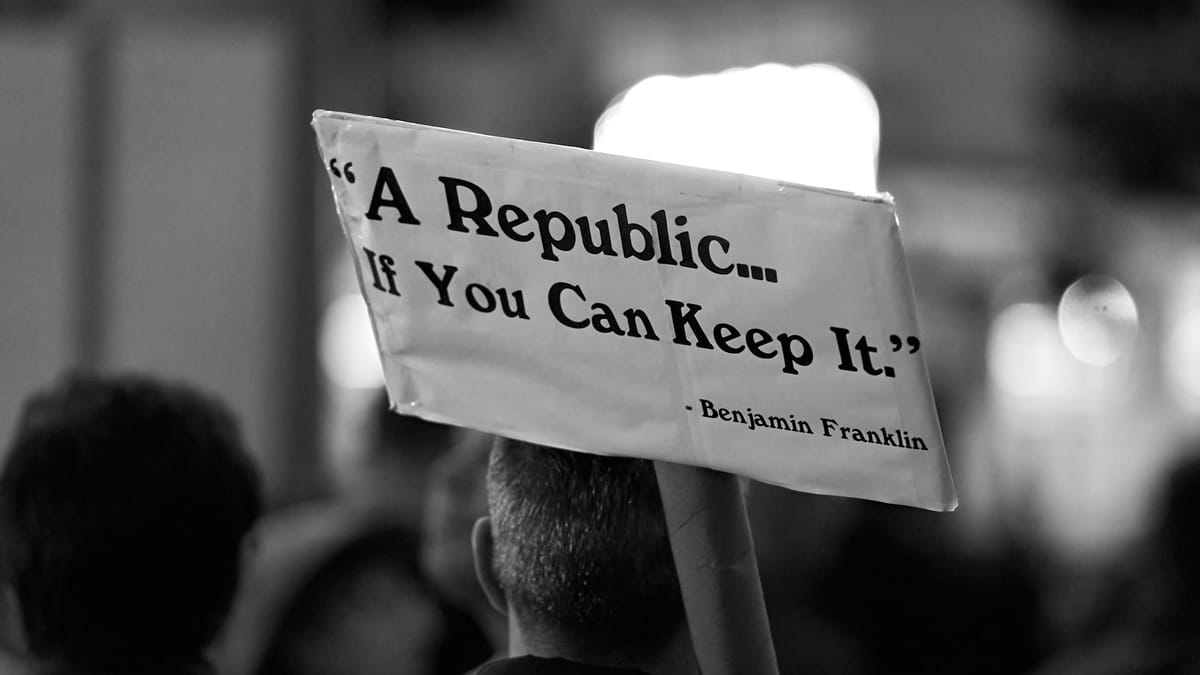
This was never chaos. It was a checklist. Here is what has been executed, what it has cost working people, and why the opposition keeps negotiating against a document they still have not taken seriously enough to name.
In 2022, the Heritage Foundation published a 900-page document called Mandate for Leadership, the operational core of what became Project 2025. It was written by more than 140 former Trump staffers, circulated openly, and reported on widely. It named specific agencies to dismantle, specific programs to cut, specific legal maneuvers to use, and a specific sequence for doing all of it. As of February 2026, the Trump administration had initiated or completed 53% of Project 2025's domestic administrative policy agenda in its first twelve months, executing 283 of the 532 recommended actions tracked across 20 federal agencies.
This is not a story about a rogue presidency operating without a map. It is a story about a map that was published, distributed, and ignored by the people whose job it was to read it.
The DHS shutdown, the SAVE America Act, the TSA patch that passed overnight, these are not isolated crises. They are chapters. And the chapter after this one is already written.
What the Playbook Said, and What They Did
Project 2025 did not hide its intentions. It organized them by agency, assigned them to authors with government experience, and published them in sequence. The only question was whether anyone on the other side was reading.
The Federal Workforce
Project 2025 called explicitly for converting career civil servants into at-will political appointees through a mechanism called Schedule F, stripping union protections from federal workers, and using DOGE-style efficiency operations to hollow out agencies seen as resistant to executive control. DOGE eliminated collective bargaining authority for roughly two-thirds of the federal workforce using a rarely used national security provision of federal labor law, affecting the Defense, State, Veterans Affairs, Justice, and Energy departments among others. More than 350,000 workers have left the federal government's payroll since January 20, 2025. Those cuts disproportionately hit Black federal workers, for whom government employment has historically been a primary pathway to middle-class stability, offering union protections, long tenure, and retirement benefits that the private sector rarely matches.
Immigration and Enforcement Architecture
Project 2025 called for expanding ICE enforcement operations, eliminating sensitive location protections, and embedding immigration enforcement into the broader security apparatus in ways that made it structurally inseparable from other DHS functions. The $75 billion in immigration enforcement funding embedded in the One Big Beautiful Bill was not a budget line. It was infrastructure. That reserve meant ICE officers kept getting paid throughout the entire 42-day DHS shutdown, while TSA workers went without paychecks, because ICE had access to separate funds Congress approved last summer. The shutdown was designed to be asymmetric. The playbook said so.
Education and Public Health
The Education Department's Office for Civil Rights sent letters threatening to cut funding to schools engaging in diversity, equity, inclusion, and accessibility efforts, and banned public school curricula from teaching systemic racism, privilege, or implicit bias. HHS issued roughly 10,000 reduction-in-force notices, including deep cuts at the FDA, CDC, National Institutes of Health, and Centers for Medicare and Medicaid Services. Project 2025 named every one of these agencies. The chapter authors had government titles next to their names. This was not a think tank fantasy. It was a staffing plan.
The Record, Month by Month
What happened, and what it cost.
- Jan 2025, Cabinet Confirmations. All 22 nominees confirmed, including RFK Jr. at HHS, who now oversees Medicaid, the CDC, and the FDA. Not one nominee blocked. Cost: the agencies most responsible for working-class health are now led by people who campaigned against them.
- Jan 2025, DOGE Launches. Two million federal workers received buyout emails within a week of inauguration. Mass probationary firings followed. More than 350,000 workers have left federal service since January 20. Cost: Social Security offices understaffed, VA wait times rising, food safety inspections delayed, and a generation of public servants pushed out of careers that took years to build.
- Jan to Mar 2025, USAID Dismantled. 83% of programs canceled. Cost: a Lancet study projected 14 million additional deaths by 2030, including 4.5 million children under five. American farmers in Kansas and Wisconsin lost $2 billion in annual crop purchases USAID made for humanitarian aid.
- Feb 2025, Federal Collective Bargaining Gutted. Two-thirds of the federal workforce lost collective bargaining rights via executive order. Cost: workers at agencies including Defense, VA, and Energy lost their right to negotiate over pay, safety, and working conditions overnight. Courts partially blocked it. The order remains active.
- Apr 2025, Liberation Day Tariffs. A 10% minimum tariff on nearly all imports triggered a market crash and a retaliatory spiral. Cost: Penn Wharton projects a $22,000 lifetime loss for a middle-income household. The bottom income quintile absorbs the largest proportional hit. Working-class families pay a regressive tax so corporations can call it trade policy.
- Summer 2025, One Big Beautiful Bill. Passed on party-line reconciliation. Cut taxes for corporations and the wealthy, stripped clean energy investment, and embedded $75 billion in ICE enforcement. Cost: every DHS negotiation that followed was structurally rigged before it started. Democrats spent two shutdowns negotiating against a $75 billion backstop they voted to let pass.
- Oct to Nov 2025, Shutdown One. Forty days. Public blamed Republicans. Democrats won off-year elections. Then eight senators accepted a handshake deal with no binding ACA commitment. Cost: more than 20 million Americans face premium hikes as ACA subsidies expire. The leverage that could have protected them was traded for a promise that was never kept.
- Dec 2025, The ACA Vote. The Senate held the vote Republicans promised. It failed. Cost: nothing was gained from 40 days of shutdown except confirmation that the handshake was theater.
- Feb 2026, Tariffs Struck Down, Then Reimposed. The Supreme Court ruled IEEPA tariffs unlawful. Trump immediately imposed a replacement 10% tariff under a different authority. Cost: the average household pays $1,230 in tariff costs in 2026 alone, with no refund process in sight and companies like Costco, FedEx, and L'Oreal suing to recover what they passed on to consumers.
- Feb to Mar 2026, Shutdown Two. Democrats entered with a 10-point ICE reform agenda. Republicans rejected every structural demand. Democrats accepted a deal with none of it in statute. Cost: agents are still masked. Warrants are still administrative. ICE kept operating on its $75 billion reserve throughout. Schools, hospitals, churches, and polling places have a verbal commitment from a cabinet secretary, not a law.
The running tab: Higher prices. Fewer workers. Weaker unions. Gutted agencies. Unprotected communities. And a $75 billion enforcement machine that never missed a paycheck.
What the Playbook Says Is Coming Next
The remaining 47% of Project 2025 does not disappear because the shutdown ended. It enters the queue. Congress returns April 13. Here is what is already written.
The SAVE America Act and Election Control
The SAVE America Act is not a standalone bill. It is Project 2025's elections chapter made legislative. It would require proof of citizenship to register to vote and photo ID to cast a ballot, and Republicans are attempting to move portions of it through reconciliation, bundled with ICE funding and potentially defense spending, when Congress returns from recess. Legal analysts note that election law provisions almost certainly cannot survive the Senate's Byrd Rule review, since reconciliation is limited to provisions that directly affect the federal budget. But the attempt itself is the point. Every week spent running that play is a week the ICE reform conversation gets deferred. The SAVE Act does not need to pass to do damage. It just needs to consume the calendar.
Medicaid Block Grants
This is the item most people are not watching, and the one with the most direct impact on working-class communities. Project 2025 recommends converting Medicaid from a federal entitlement program into block grants or per capita caps, fundamentally restructuring how federal health coverage for low-income Americans is funded. Under block grants, states receive a fixed amount of federal funding regardless of actual costs, with caps typically designed to fail to keep pace with enrollment growth, recessions, natural disasters, or new drug therapies. The April reconciliation package Republicans are assembling is the vehicle. For children with chronic conditions, the impact is immediate: block grants would allow states to impose lifetime benefit caps, eliminating coverage for costly treatments and therapies that private insurance does not cover.
Schedule F and the Permanent Workforce
This is the quietest item and the most structurally dangerous. Project 2025 calls for reclassifying tens of thousands of career civil servants as Schedule F employees, stripping their civil service protections and making them removable for any reason, or no reason. DOGE was loud and litigated in real time. Schedule F is administrative and nearly invisible. It means that every regulatory agency, every inspector general, every career attorney who provides institutional continuity across administrations becomes a political appointment. The next administration does not just face a different policy environment. It inherits a workforce that has been politically vetted from the inside out. Project 2025 called this the precondition for everything else. They were right.
The playbook was published in 2022. It was 900 pages long. It had a table of contents. Fifty-three percent of it is already done. The rest is scheduled.
The midterms are in November 2026. Democrats need a net gain of three House seats to take the majority. If they get there without having blocked a single Project 2025 item in statute, without having protected Medicaid, without having codified a single ICE accountability measure, the majority they win will be handed a government that has already been structurally reorganized against them. Schedule F will have converted the career workforce. The independent agencies will be under executive control pending Supreme Court rulings. The election machinery will have been pressured at every level the SAVE Act could not reach legislatively.
Winning the House matters. But winning it into a hollowed-out government, having spent two years negotiating promises that expired on contact, is not a recovery. It is a longer timeline to the same destination.
The checklist is 900 pages. Fifty-three percent is done. The people paying the cost of the remaining 47% are not lobbyists or party strategists. They are the ones who cannot afford a premium hike, who lost a federal job, who live near a school that was supposed to be a sensitive location. They are the ones who needed the leverage that kept getting traded away.
Read the document. Name the chapters. Hold the line.
Take action: Call the congressional switchboard at 202-224-3121 and ask your senators where they stand on Medicaid block grants and Schedule F before the April reconciliation vote. Use 5Calls.org for a guided script. Leave a comment for the administration at 202-456-1111.
Track every item in this piece: ourrevolution.media/project-2025
Our Revolution Media is an independent publication rooted in LA. No ads. No sponsors. No corporate backing. If this reporting is useful to you, support the work.
Independent. Unbought. Unfiltered.